Showing posts with label gardening. Show all posts

Monday, May 28, 2018

Potatoes - And a Ton of Dirt.,,


 So I decided to try growing potatoes.  Decided to do it in burlap sacks.  Over the last few months I ended up with too many potatoes that started sprouting before I got them cooked, so mostly the seed potatoes were just potatoes saved from the compost pile, although I did get some seed potatoes from the Resource Center over at the Garden Project https://greaterlansingfoodbank.org/programs/programs-home/the-garden-project/ as well.  I had  total of 4 types of tatties, and I also got the burlap sacks from the Garden Project (leftovers from Coffee roasters. 
So, I pulled the trailer full of dirt up to the area of the driveway nearest the spot I was planning to use, put down some landscape fabric, and tucked in.  As you can see in the pictures I used a cardboard box with the bottom flaps cut open to keep the burlap bags standing up while shoveling dirt into them.  I put in about 4 inches of dirt in each of the 12 bags, planted potatoes about 8 to 10 inches apart in the bags (4 in each bag, the bags are 24x36 inches when flat so about 1.5 feet across when full), then covered with another 4-5 inches of dirt.  And as I was getting to the end I was hoping I had enough dirt.  Eventually poured the last dirt off the tarp into a bucket to finish filling the last bag, and had to steal a little dirt from a couple of the more full bags to make sure the least filled bag was full enough, but that did it.  So I have used the first trailer full of dirt.  My trailer can only officially handle 900 pounds, but I had bought a half-yard of dirt, which depending on moisture content can weigh half a ton plus or minus a bit of water.  Luckily it was pretty dry when I bought it, but I have now shoveled over a half ton of dirt this year, as this isn't the only shoveling I've done.  I was just saying this winter that I needed to add Strength Training to my walking workouts, and I think Gardening is adding that strength training in the form of shoveling and, well, I've also poured a full bag of Perlite and fifteen 2 cubic foot bags of Potting Soil.  Well, 30 cubic feet is more than a cubic yard, so I guess I've moved 1.5 tons of dirt this year, some of it more than once (container gardening means you can change your mind on what goes where).

Sunday, May 27, 2018

Successes and Less Successful stuffs.


Today's conundrum: 

My first strawberry is blooming.  The gardening wisdom is that if you plant in springtime you should remove all of the flowers the first year so that you get much healthier plants and much more and bigger and healthier berries in following years.  I did not, however, realize how hard it would be emotionally to actually cut the flowers.  I went back and researched, and apparently everyone from gardening web sites to University Extension services to people who sell strawberries say that yep, you need to snip the flowers.  They say that maybe day-neutral or everbearing plants you could stop snipping  after June.  I knew that going in, and I planted June-Bearing berries in this planter.  So... I decided that I will let them bloom, but snip the flowers when they start to wilt so they don't put a lot of energy into the berry/seed production.

If the strawberry seeds I sowed in the other two planters don't germinate and grow, I will get more seed and try germinating in a controlled environment, then planting this fall, since they say that you don't have to snip fall-planted strawberries.

I knew going in that not everything in the garden would be a resounding success...  and so far the greatest failures have been garlic chives not growing yet, one of the lettuce varieties not surviving the frost/freeze cycles we had, a parsley plant that the squirrels stole, and spinach that started bolting before we got a real good harvest.  As far as the spinach goes, we will replant that for fall and hope it doesn't bolt, then try different varieties next year.  We have new parsley plants that have real root systems (the missing plant was an accidental "grew some small roots while we were keeping it alive in a bowl" plant, so didn't have the ability to stay planted when they tugged on it).  We can replant garlic chives and if that variety doesn't take get some other seeds... and the regular chives are taking off.

Saturday, May 19, 2018

A Cornucopia of Greens


This morning we HAD to thin the lettuce towers, along with some radishes, turnips, peppercress, and possibly other items.  The Spinach in the towers had finally fully Bolted so it was weeded out.  We may have a little spinach from the second container before it bolts, as I read on one article that the later you plant it the longer it takes to bolt.

Anyway, we didn't actually harvest any full plants...  well, there were maybe a half dozen that were growing in the wrong place, like a Tango growing in the Bronze Beauty section or something, and there were a few places where the plants were so thick that a couple got pulled entirely to leave room for the others, but overall this was just thinning a few leaves off of each lettuce plant, cutting some peppercress, and thinning some radish and turnip beds.  I put the gallon jug there for size context.  We will be sharing with family and friends, as we already got a head of lettuce from our CSA on Thursday, so we currently have a bounty!

We were somewhat disappointed in the spinach.  If anyone in the north here has suggestions for a spinach variety that produces greens for a month or more instead of a few weeks we would be interested to hear about it.

Oscar


Monday, May 14, 2018

Forsythia, Ajuga, and realizing I can't do it all


Diana bought us two Forsythia shrubs.  Forsythia is a bush that my father grew, and in fact he planted two of them, telling my sister and I that the second bush was "Firesythia", because Fire (pronounced Feer-Ah) is the number 4 in Norwegian.  As a kid I heard it as "Feedasythia" but whatever the pronunciation the point is that he made up a name for it and so the bush took on a special meaning for me after we lost Daddy.

Because we have such a small yard Diana bought a dwarf variety, and to keep it affordable she bought small plants, but the shrub, over time, will get to be nearly 3 feet across.  I don't want to crowd my neighbor, and his driveway runs exactly down the property line, so I cleared a little plot that is along the driveway, sidewalk, and the arc that is 4 feet from the corner of the sidewalk/driveway.  Planting the shrub 2 feet from the sidewalk and 2 feet from the driveway should keep it from sticking out over either.  To keep the slope from eroding, help with the pollinator factor, and also a nod to Daddy I will also be planting Bronze Leaf Ajuga (Bronze Beauty Carpet Bugle).

It took me 2 days to dig out the sod/weeds/roots/stones and bricks for ONE side.  Yep, 10 bricks were buried in that little plot!  Also, the ground was quite wet from the weekend rain, so the clay in the soil stuck to the roots of the sod... I don't want to give the weeds dirt to grow in, and I don't want all of the good soil to go away (there is clay, sand, and humus/compost in the soil, not just clay).

We have so much to do and these new garden beds are taking me so long that I decided to hire some local college students ("Rent-a-Rower" from the Michigan State University Crew team) to help with some of the additional garden digging - they should be here next week.  Meanwhile, I can move on to other gardening tasks!

Friday, May 11, 2018

Monarch Garden


Even though it was raining a lot today, I had decided that I needed to make today the day I got the Monarch garden in, or at least the Milkweed plants that were so kindly given to me.  Last night I finished digging out the sod and roots and bits of metal and rocks that were in the spot.

This morning I raked the dirt, and it was clear that all of the bulk removed when I removed the sod had dropped the level of the dirt an inch below the lawn, so I filled the wheelbarrow halfway or so with some of my recently purchased dirt and dumped it on the patch, then raked it smooth.

Once I had the garden ready, I put some stakes in to give me a rough guide for where to plant which flowers.  I started with a row of Cypress Vine (think Scarlet Morning Glories) against the fence, then planned for a staggered row of milkweed (two of the stakes in each set), then Black-Eyed Susans (Rudbeckia), Daisies, and Dwarf Blue Sage. 


In order to make the plants even, I made myself a measuring stick.  Using a measuring tape when actually crawling around on the ground has too many issues, so I made one out of scrap wood.  I made a full line every 12 inches, and along one edge I made half-lines every 4 inches, while on the other edge I made half-lines every 6 inches.  I can use this to plant at any multiple of 4 or 6 inches (some of my plans were for 8 inches, for example).  Since the stick is heavy and rigid I don't have to worry about wind.


So, I used the stakes and the stick, and to make sure I didn't sink too far into the fresh dirt I used a scrap piece of plywood shelving to kneel on, and planted the Cypress Vine and the Milkweed.  The Rudbeckia, Daisies, and Sage will have to wait, because the important thing for me this weekend is planting live plants (I did the Cypress Vine because it is behind the Milkweed), and I have Forsythia bushes and Ajuga plants, plus my Tomato and Pepper plants to get in the ground.

Thursday, May 10, 2018


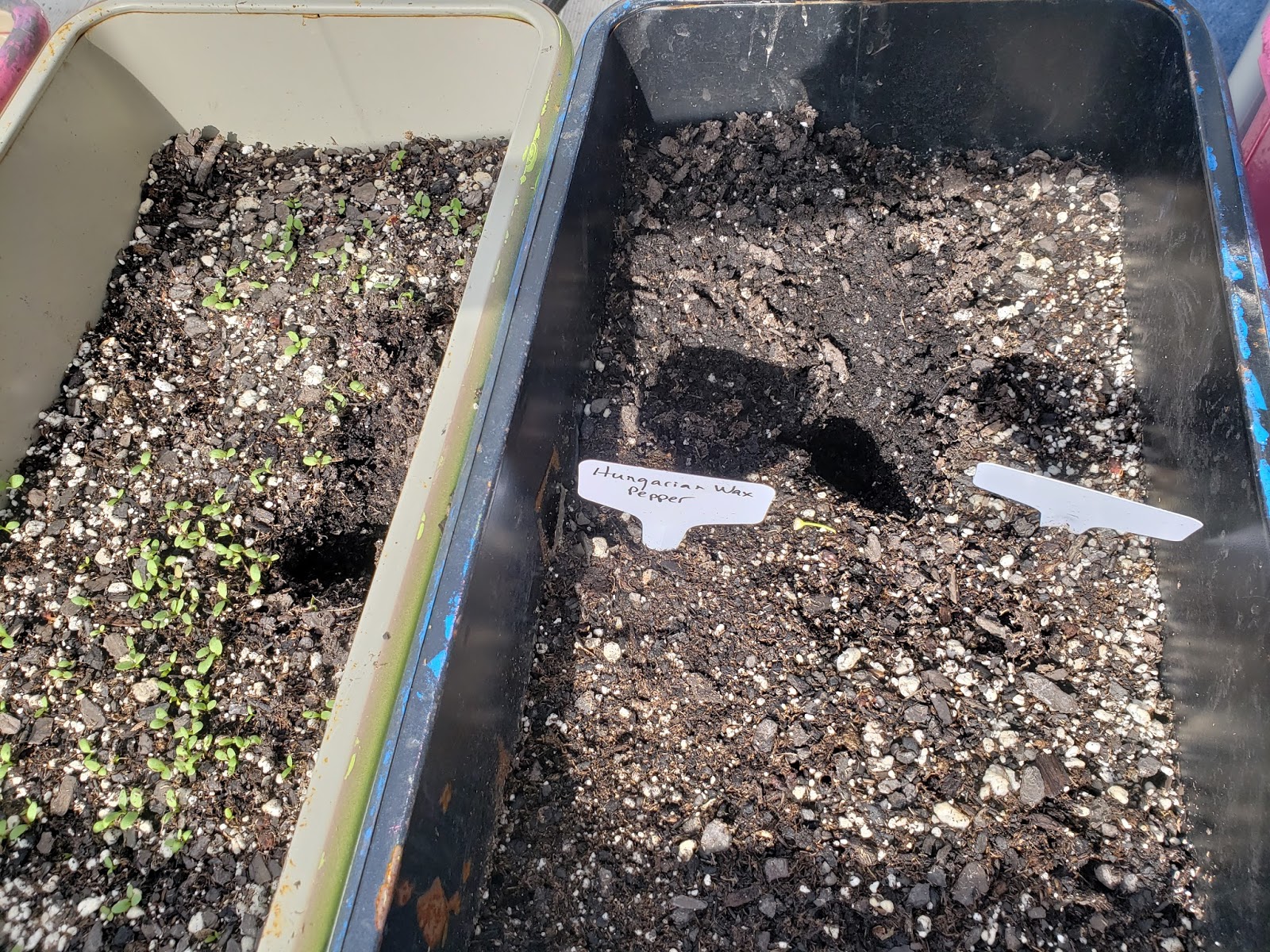
So the squirrel(s) have visited the garden again.  I don't think they even ate anything... the first picture shows that they dug a hole between the only two plants that are planted there (they already stole the parsley that had originally been the third plant - maybe they were looking for it again?), and the plants in the other two containers are small enough that the holes they dug wouldn't have been needed.  Either they just like doing damage or they buried something of their own in my dirt because it was easier than digging in the yard.

Oh well, the lettuce is doing well enough that tomorrow will be another salad day!

And I finished digging the garden bed for the first section of pollinator garden - so in the morning I can plant my milkweed and a couple of other native (wild)flowers in an 8 foot wide bed.

Wednesday, May 09, 2018

Backyard to Table Microgreens!!!


First garden meal - well, not a full meal, but Diana and I each got a full bowl of salad microgreens from thinning the spinach, lettuce, beets, turnips, radishes, and a little peppercress.  Extremely tasty, and you can't get much fresher than picked less than an hour before eating.  Even more important, since we grew it and picked it and washed it, we know EXACTLY how it made it from seed to table.

All from our container gardening, and we can go right back out tomorrow or Friday and do it again... just from thinning the plants.  For example, below is a picture of the garden towers and all of their lettuce and spinach.  You can see that the openings are crowded, so even with the leaf lettuces we can probably pick 50-75% of the and still have a reasonable batch growing to full maturity.


Monday, May 07, 2018

Community Gardening


So on Sunday I found out which plot of land I get at the Community Garden and met the garden leader.  Because new gardeners often try to bite off more than they can chew, The Garden Project of the Greater Lansing Food Bank assigns first-year gardeners a 10x20 foot plot.  Plenty to grow a lot of food, but not so much that it is likely to discourage a gardener from coming back year after year.  If you come back the next year and want a larger plot, you can do that.  The garden I selected a few blocks from home turns out to have been recently enlarged, and the plot I was assigned is luckily on one of the sunniest spots, and not down in the boggy end of the garden.

Now I just need to finish planting the living plants in the home garden... the ones that are not in the ground yet... so they don't die on me.  I have two Forsythia bushes, 12 milkweed plants (4 each of 3 kinds), 2 tomato plants, a dill plant, a dozen ajuga plants, plus 2 cabbage plants for the community garden.

After that I can get to planting in the Community Garden plot... the melon, squash, cabbage, rutabaga, and other vegetables that we didn't have room for here at the house.  I have another 3-day weekend planned, hoping to catch up on at least some of the tasks that I didn't finish last weekend.

Maybe tomorrow we can thin the lettuce, spinach, and peppercress enough for a small salad.  If so, I will try to get some pictures of the containers we are harvesting from...  It amazes us how well the garden is doing already!

Oscar

Saturday, May 05, 2018

Strawberries


It has been a busy and non-garden oriented day... So I am going to talk about my strawberry strategy.  I heard from many people in my area that birds, squirrels, and possibly other animals tend to steal all of their strawberries, so I hope to grow mine in hanging baskets - then bring the hanging baskets into my screened in porch after the berries start to grow (after the flowers have been pollinated).  The first of three varieties I am growing this year, "Old North Sea", are from a viking settlement - shipped as plants and so I got them in the planter early.  I bought planters for my other two varieties today, so hopefully by the end of the week I will have the "Red Wonder Wild" strawberry (berries are supposed to be extra sweet and flavorful but wilt within an hour or two of picking so need to be eaten fresh immediately) and "Attila" alpine strawberry planted.

Thursday, May 03, 2018

Purple People Feeder


I mentioned the Purple People Feeder - here is a picture of it and the flowerpot that the Zinnias are in.  The large bin is 22 inches by 24 inches, and over 18 inches deep - Food Grade plastic with four wheels.  It was milky white, but because Purple is special to me I chose to spray paint it.  Because it is deeper than any of the other containers we can grow different items in it - long carrots or long beets or anything else that can take advantage of either the width or depth of the larger bin.

For many of our containers we are hoping to succession plant - as in planting a second or sometimes even third or fourth crop after the current crop is harvested.  Some of them we even companion planted, like putting early turnip or radish seeds in with carrots - the turnips and radishes will be picked and eaten before the carrots even poke their leaves out of the ground.

Garden Towers


Last year we bought two Garden Tower 2 planters (Garden Tower Project).  They look almost identical to this picture except that ours have casters (wheels) on the three legs, and ours have dirt (and plants).

We had decided to try these as an option for container gardening that Diana could reach from her chair.  The total depth of soil is probably 4 feet, but they are designed such that there is a section in the middle where you feed compost into the center of the top, you put in Red Wiggler worms (the kind used in vermicomposting), and the worms and the compost is supposed to make them awesome.  There are 6 layers, and at each of the lower 5 layers there are 9 openings (45 total), then the top is shaped the same around the edge (9 "bumps"), but there is more width of soil, probably at least 6 inches from the edge to the edge of the center tube (which has a cover).

These were actually the first containers we planted, and when the nights were getting down into the 20s we used 55 gallon clear plastic "drum liners" to cover them to keep in the warmth and moisture.  The spinach on top of one even survived the ice storm when we ended up with two inches of ice over a five inch wide oval part of the soil.

At this time I can say that the experiment is sort of working.  We haven't started with the compost or worms yet, and the fact that we don't have anything working in the center means that we have to water these more than the other containers, but we have Spinach that is almost 2 inches high, and we have so many lettuce plants that we are going to have to thin some of the varieties soon.  Also, watering these when the seeds were freshly planted ended up with some of the seeds washing down to the next level.  I would say that next time we plant these we will want to soak the soil first so that we don't have to water the plants for a few days.  Extra water collects in a drawer that pulls out of the bottom, and once you have compost and worms working the center, the water that falls through becomes worm-compost tea.

We may not have them set up optimally, but as we progress I expect they will get better.  The worms should be able to survive our winters if we pull these into the garage or at worst the back porch.

Oscar

Tuesday, May 01, 2018

Milkweed, Monarch Butterflies, and other Pollinators


Last night I went to a workshop on pollinators (bees, butterflies, wasps, birds, etc.) and how to make a home garden more hospitable to them.  I found out that Monarch Butterflies need milkweed to hatch eggs, and that there is a shortage of milkweed in this area.

It turns out that one of the people there is a major advocate of Monarch butterflies, and he offered me a few plants.  I was thinking plants like the 4-6" plants you usually see growing in flats that you can buy... but when I picked up the plants today to my surprise some of them are 20" tall.

Dave was kind enough to provide me with a few plants each of three varieties of native Michigan Milkweeds, the "Common Milkweed", "Swamp Milkweed" and "Butterfly Milkweed".  I especially like the look of the Butterfly Milkweed, pictured above right.

We are very lucky to have found a source of such vigorous plants.  I know he has uses for them elsewhere, so I am feeling very honored today.

Oscar

Monday, April 30, 2018

Wastebasket Gardening, part 2


Yesterday's picture was an "in place" view of these stands.  Basically, I found some free kitchen shelves at MSU Surplus (Michigan State University), and made these "stepped" boxes to allow our containers to be at the right height for Diana to tend from the wheelchair.  Other than the screws and time, the boxes were made from 100% "upcycled" materials.  The containers are 1960s vintage steel trash cans... After this picture was taken I drilled a number of 1/4" holes in each one for drainage.  Then, I put down some rubber mulch nuggets to even out the ground between the rails of the two parts of the wheelchair ramp, put the boxes in place, put the containers on the boxes, put 3-4 inches of Perlite in the bottom then filled the rest with potting soil.  There are a few containers along the outside of the ramp as well, and 4 more of the round ones for planting in the front yard near the front steps... so a total of 16  rectangle (about 8"x16") and 9 round (about 13" diameter), plus a large tub I call the Purple People Feeder (about 23" square and deeper than the wastebaskets) and a couple of plastic planters - and all but the four for in front are full of dirt and planted with seeds or plants.

Oscar

Sunday, April 29, 2018

Lansing Wastebasket Gardening


About our Lansing Garden:

Oscar and Diana moved to Lansing in 2017 after purchasing a home on 1/10th of an acre.  They each have food allergies, and prefer the intense flavors of organic and ultra-fresh produce.

Oscar did garden tasks as assigned while growing up in the 1960s and early 1970s but didn’t really value or learn about gardening in a useful manner.  Since then he has attempted gardening twice with mixed results – the vegetable garden he tried one year was about 8x12 feet and the only crop he got was about half a dozen bell peppers.  Later, the flower gardening from 3 homes ago went pretty well, but the only edibles were currants, gooseberries, and black raspberries.  The black raspberries were very vigorous but produced for about 2 weeks a year and needed to be well watered during that season if they were to be good berries, and the currants and gooseberries did well for a year or two but eventually succumbed to an insect infestation.

Diana grew up in the country and her family always had a garden growing up.  She has a degree in Resource Development which was part of the College of Agriculture and Natural Resources.   She has gardened before, but this is the biggest gardening project for edibles she has ever attempted.

The Lansing Garden posts will be about our successes, failures, opinions, reviews of plant varieties, products and ideas, and in general about our attempts to improve our groceries.  The first year will probably not be as cost effective as just buying everything organic from stores and local farmers, but we will be trying varieties of produce that are not typically available.  For various reasons, a LOT of our gardening will be in containers, but in addition to the gardening at our home, Oscar is also signed up for a Community Garden plot about 6 blocks from home.

Thursday, May 31, 2012

Bonus Feature

Yesterday Oscar didn't have to be at work until 12:30, so we got up at our usual time and spent a few hours exploring our new neighborhood. One of the first things we did was visit the fitness center.
Summit Fitness Center, Canton, Michigan
 The good news is that if I pick my path carefully, I can use the manual wheelchair to access the facilities. I cannot wheel myself up even a small degree of incline without risking permanent damage to my ill-healed hernia repair. Right now my weight lifting limit is just under 10 pounds. If I damage the remaining muscles that will plummet to 2 or 3 pounds. My primary doctor is also an internist who was able to warn me about this limit before damage was done. The surgeon that did the repair told me my limit was 20 pounds, and did not change it after my healing was botched. Again, I am so very grateful for my current doctor.
Anyway, the good news is a path exists. The bad but far from catastrophic news is that my endurance is lower than I have ever felt before. Remember before all this happened I used to hike up and down mountains for 12 hours at a time every weekend when I lived in Japan. It was somewhat of a disheartening reality check to fully understand how my overall strength has waned. Given my fibromyalgia I will need to be careful not to over do things, but after moving to the new apartment I will be using my manual wheelchair inside all day. That combined with making trips to the workout center with Oscar as back up should allow me to regain some of my stamina. We will begin attending the center in September.

Then we clocked the distance between the center and what will be our new front door. It was a bit over 4 miles, but a huge swath of it was without sidewalks.. thus being able to use the manual chair to travel in the van became very important (the ramp is too small for my electrical chair, which means I am unable to get it back on the ramp without someone spotting me. (there is 1/4-1/2 inch clearance on each side.) With the manual chair I can load myself up, drive to the center, work out, load myself back up and drive home.
At our current home there is no place I can park the van and access the ramp with the manual chair, so the handicapped parking at our new place opens up tons of opportunities for me to go around on my own. We need to get the van's brakes fixed, and I need to choose places without carpeting so I can get around easily but in essence, with the change of address great freedoms which have been lacking for a decade become possible.

As we drove around our new apartment complex I noticed some people with patios like ours have flower beds! This means the management is amenable to minor landscaping... this means we can have the huge overgrown shrubs that block our sunshine totally removed, and replace them with raised flower beds of a height I can reach them from my chair... this means I can GARDEN!!!!!!!!!!! and !!!!!!! for good measure.
Oscar and I will discuss what to plant over the winter, but just the thought of being able to dream about what to put in means that I will have a very cheerful winter indeed!. There is also lots of inside sunshine so I can have some flowers and herbs in the house, too. That I will start soon after we move in.

While driving back in the direction of current-home, we clocked the distance to Ikea and Michael's Crafts... less than half a mile! There is a short 1/2 block stretch where there is no sidewalk, but in good weather I can use the electrical chair on the grass and still get there. There is a cross walk over the only street I need to get across. (Yes Lynnie, I promise I will put a rhinestone studded whirligig on the back of my chair to increase visibility, even though I am really a lot bigger than a bicycle. :-} )

Before heading home we stopped at our local Coleman's which is a vegetable and fruit 'stand' (actually more of an open air building) There we picked up Romaine Lettuce and Asparagus that had been cut that morning  as well as some HUGE radishes and some lovely scented strawberries for Oscar. They also were displaying their (mostly) annual bedding plants. I took the opportunity to shoot some photos with my phone, and dream a bit. The double flowered impatiens reminded me that I used to take cuttings of that same variety and grow them over the winter to plant each spring (bottom photo, lower right hand corner.)Maybe I'll pick up a pot of them before they run out so I can start that tradition again... Something new to bring to our home along with an ivy plant I have had since February.